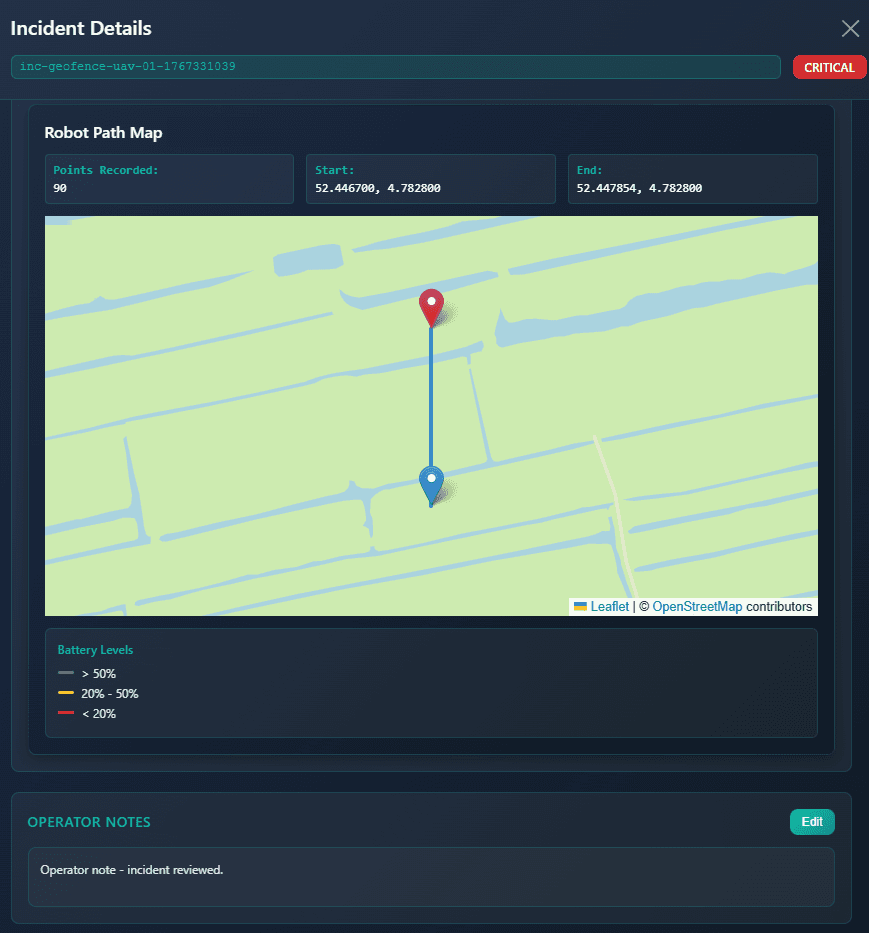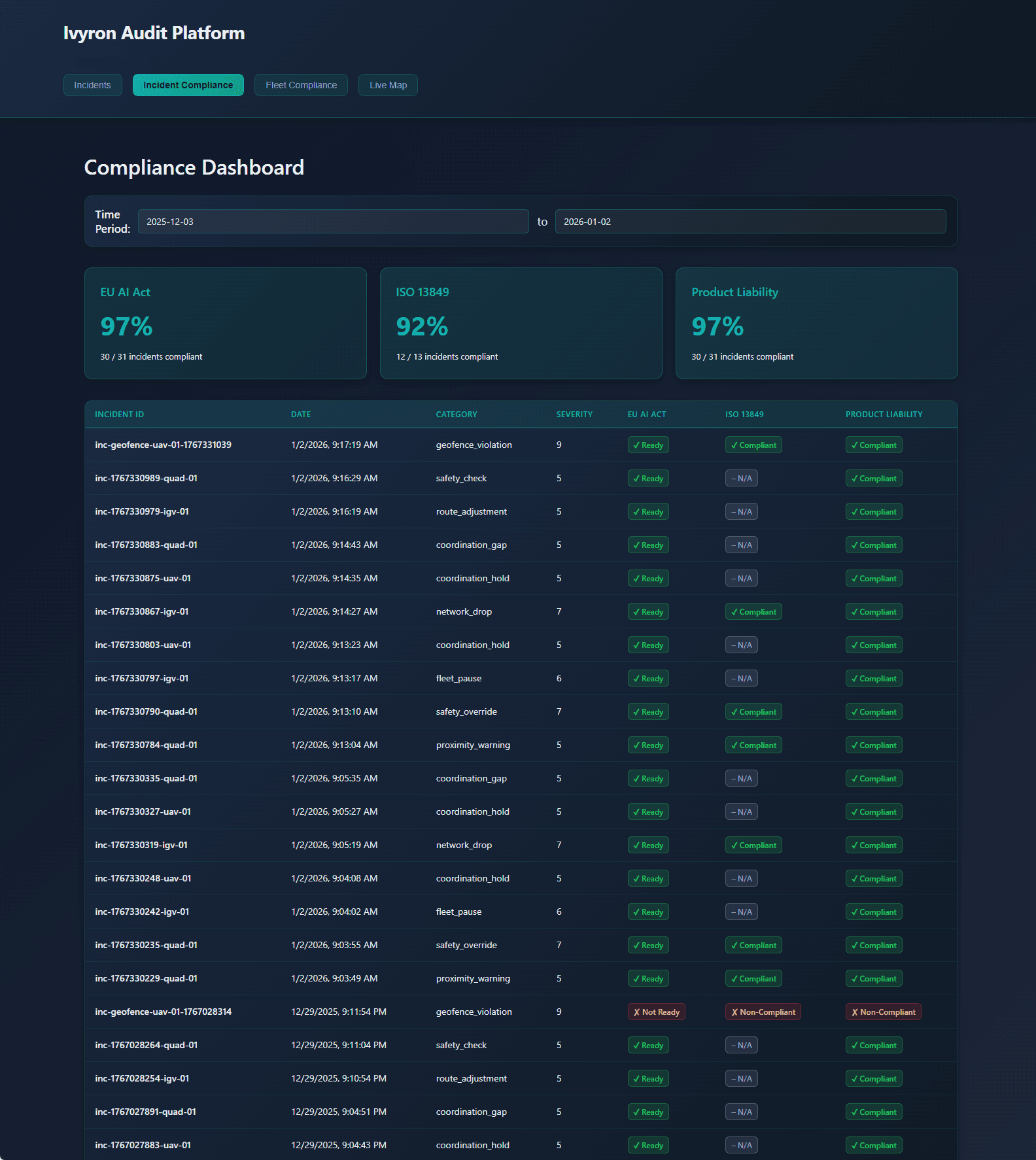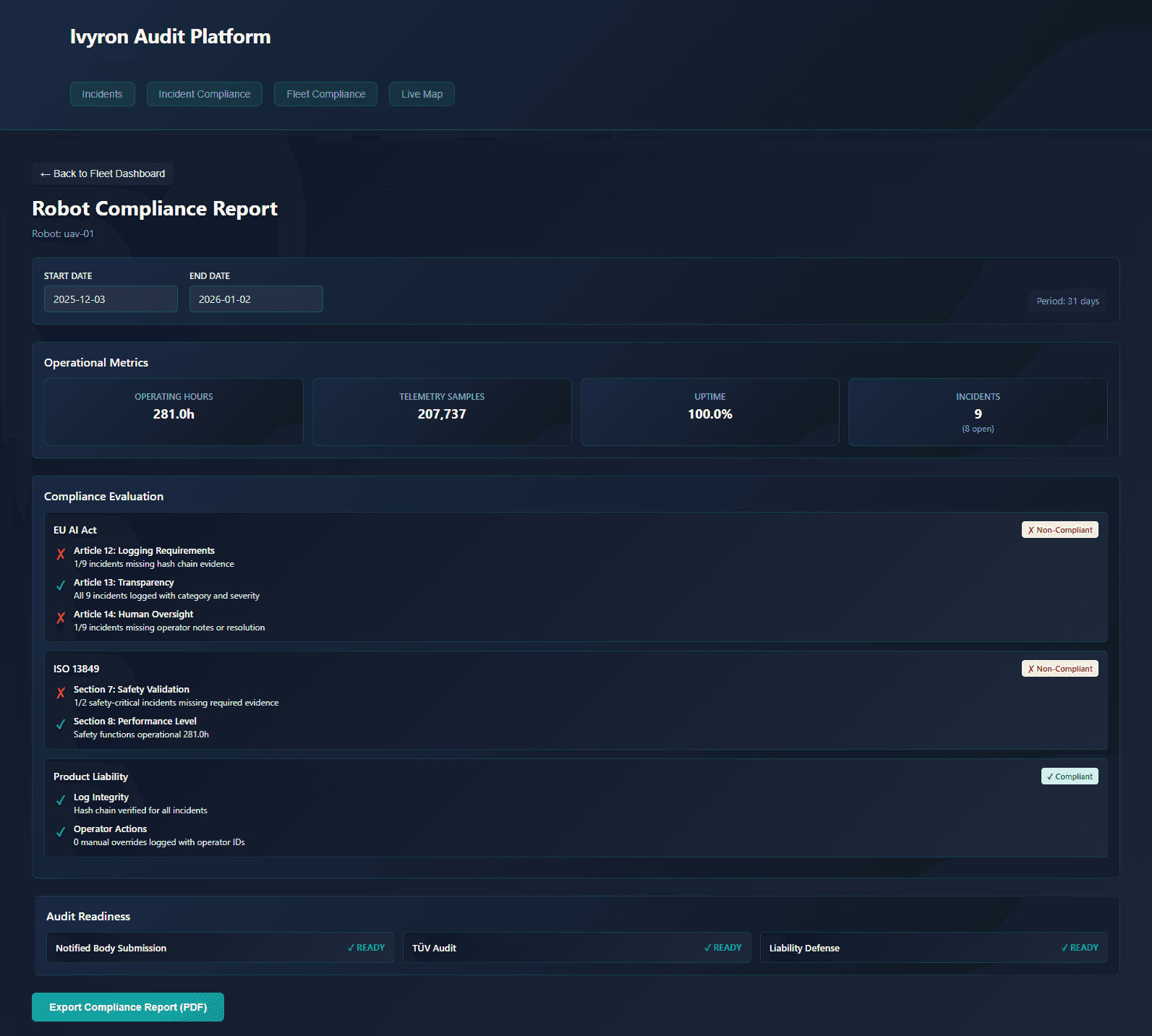
This page is for technical, security, and compliance reviewers assessing Ivyron Audit. It covers evidence capture and preservation, deployment boundaries, and the explicit separation between Ivyron Audit and operational robotic systems.
Purpose and scope
Ivyron Audit is an evidence and audit infrastructure for autonomous systems.
It is not:
A compliance advisory service
A certification or conformity assessment tool
A control, orchestration, or operational system
The system evaluates the presence, structure, and integrity of operational evidence, not whether an organization is compliant.
Read-only, vendor-independent
data capture
Ivyron Audit ingests telemetry in a read-only configuration using existing robotics and IoT data interfaces.
It captures post-execution artifacts from customer and vendor systems into an evidence record that is not controlled by the underlying platform vendor, without command injection, control-path integration, or participation in decision-making loops.
It does not modify source data or influence execution timing.
Deterministic evidence evaluation
Evidence evaluation is implemented using explicit, inspectable rules - with no machine-learning models, probabilistic scoring, or automated interpretation of regulatory intent.
Results are reproducible and auditable. The same inputs produce the same outputs.
Record integrity and verification
Evidence records are cryptographically linked in sequence, forming a tamper-evident chain. Post-hoc modification is detectable, integrity checks can be re-run at any time, and record integrity can be verified independently.
Local-first execution and data handling
Core services execute locally, with no outbound data transmission required for evidence capture or evaluation.
This supports operation in restricted, offline, or safety-critical environments.
Evidence is stored locally by default and designed to be reviewable and inspectable on site. Cloud-based aggregation is available for multi-site reporting and historical analysis, but is not required for core operation.
Integration model
Ivyron Audit operates alongside existing systems with explicit separation between audit infrastructure and operational systems. It does not require replacement of existing operational tooling.
Deployment is customer-managed. Where vendor support is needed, it is customer-initiated, time-bound, and under customer control.
Pilot scope and limitations
Ivyron Audit is currently scoped for technical evaluation in controlled environments.
Included: evidence capture and correlation, time-bounded event timelines, tamper-evident audit records, deterministic evidence evaluation, and audit-oriented evidence export.
Not included: long-term evidence retention, cloud-based multi-site aggregation, enterprise identity and access management, high-availability or production hardening, and formal conformity assessment or certification workflows.